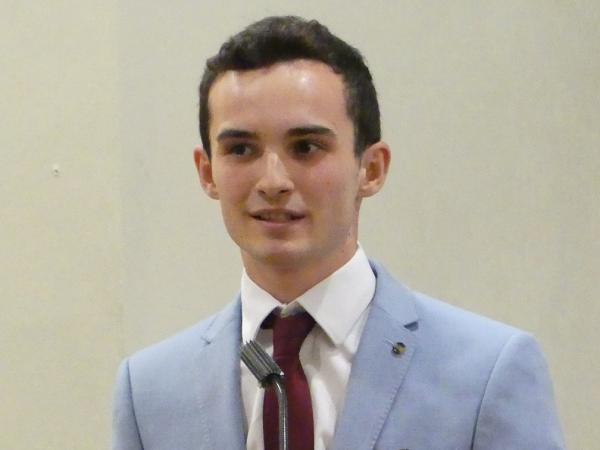
Topic: “Freedom lies in being bold” – Robert Frost
It was twenty-eight years ago when Muslims were burning copies of ‘The Satanic Verses’ in Bradford City Centre. The writer, Salman Rushdie, was forced to go into hiding like a fox fleeing its hunters. Respectable politicians (and I use that phrase loosely) remarked that this man, whose life was in danger, yes, should be protected, but probably did bring it on himself.
Now, let’s fast forward to two thousand and seventeen.
It’s not just hysterical Muslims, the favoured scapegoat for people of a certain persuasion, who are threatening our liberty. It’s your average noodle eating university student who claims to be on the hunt for freedom. Freedom to sleep with who they want, freedom to wear what they want, freedom to change whatever they want about their bodies. As Freddie Mercury sang, they want it all – just with the tiny exception of being exposed to ideas that they don’t agree with and, just for good measure, they don’t want the rest of us to be exposed to them either.
As Robert Frost so aptly put it, freedom does indeed lie in being bold. But being bold is not whining about micro aggressions and hate crime. Being bold is not moaning that somebody’s words have made you feel unsafe as if they held you to ransom. And being bold is certainly not threatening somebody who you just to happen to disagree with.
Despite our celebration of boldness, it doesn’t necessarily mean that any of us will be guaranteed freedom. Bret Weinstein, an anti-racism campaigner and professor at Evergreen State College, was unable to continue working as a result of the backlash following his rejection of a proposal that would see white teachers and students banned from campus for a day. Julie Bindel, who did more than anybody to make rape in marriage a legally punishable crime, is no-platformed by the self-aggrandised National Union of Students for a close-to-the-knuckle article she wrote about transgender people back in 2004. And the Catholic journalist Tim Stanley, who opposes access to abortion, is not allowed to debate the topic at the University of Oxford (you know, the one where the clever ones go, where our future leaders come from) because he (quote) “doesn’t have a uterus.” The words of Robert Frost, to be bold and be free, once again sound particularly relevant here, as do his thoughts that “Half the world is composed of people who have something to say and can’t, and the other half who have nothing to say and keep on saying it.”
All of these people who stand up and say what they think, despite illiberal attempts to silence them, are bold and, because of this, they are free. They are free to hold opinions and to speak freely of them. They are free to disagree vehemently with an intellectual opponent and not let that taint their character. And they are free to sit and listen to others with content – just like we are doing today – knowing that they need not be threatened by somebody equally passionate.
Our culture, on the other hand, has forgotten what it means to be free.
Being free is about opening your mind, and then your mouth; saying what you think, and being prepared to disagree – the cornerstone of democracy itself. Freedom has been hard fought for, by Sophie Scholl and Mary Kenny; Camille Paglia, and Tony Benn, and all those countless others who stood up to, and continue to stand against, those who want to see our liberty eradicated. Freedom is too precious, too important, to be dismissed by cheap rhetoric.
In Shakespeare’s ‘As You Like It’, Celia remarks to Rosalind that “Now go we in content/To liberty, and not to banishment.” That was 1599, this is two thousand and seventeen, and yet our position seems startlingly similar. It’s about time we listened to Celia. It’s time to stand up and be bold and, once you do that, you will become the personification of freedom itself.
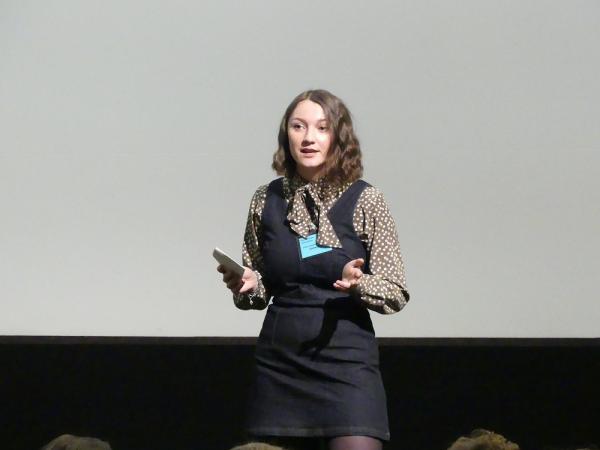
Topic: The voting age of young persons in the UK should be lowered to 16.
Teenager. What sort of words come into your head when I say ‘teenager’ to you? Young? Yeah. Adolescent? Maybe. Immature? Incompetent? Lazy?
None of these words have particularly positive connotations and the majority are inaccurate in describing young people aged between 13 and 19. Therefore, it’s patronising and presumptuous to assume that we’re all stereotypical 16-year olds, lying in bed all day, the only light we see coming from the screens of our mobile phones. 16. The age I think young people should be allowed to vote.
Being 17, I’ve seen first-hand that in todays’ world, young people are increasingly aware of the issues the world faces. Due to a rise in social media and technology, we’re more informed than ever and, like adults, have developed clear opinions about the state of the world, politically, socially and economically. In the United Kingdom, there are over 1.5 million 16 and 17-year olds. That’s 1.5 million opinions. 1.5 million opinions that aren’t heard in order to give a more equal and reliable view of the country that we live in.
By the time we turn 16, we are legally allowed to get married, leave school, be taxed, have sex, join the armed forces, change our name and even give consent for someone else to receive medical treatment. We have many of the same freedoms as adults, yet our voices aren’t heard.
I think you’ll agree with me when I say that last year was a bit of a rollercoaster ride for the world as we knew it. Not only did we welcome, perhaps through gritted teeth, the introduction of a new president, but Britain voted on our future. Britain voted on my future – something I wasn’t allowed to do. Brexit concerned 16 and 17-year olds most but we weren’t allowed to vote on something that we would feel the full effects of as we evolve into adults. One of the biggest decisions of our lives was not made by us. If there was ever a year to let young people into politics and possibly change the course of 2017, it was last year and we missed that opportunity. I don’t want to miss that opportunity again.
Throughout history, laws have changed and developed as society has changed and developed. In the same way that women gained the vote in 1918 because the law opened its eyes to equality in gender, the law now must open its eyes to equality in age. Young people have changed. We’re not the same as teenagers 50 or 60 years ago. Nowadays, we’re more interested than ever in what’s shaping our future in a world that’s seemingly becoming tougher and harsher on us. Standing back should never be an option, let alone a law. In Scotland, it’s legal to vote at the age of 16 and in 2015, 75% of 16 and 17-year olds voted in the general election. We’re shouting. Young people are shouting. We want to be heard.
Topic: A fact does not cease to exist if it is ignored
What is a ‘fact’? The dictionary definition of a fact is ‘a thing that is known or proved to be true’, but if we do not know that something exists does it mean that it doesn’t? Throughout history politicians, doctors, and religious leaders would argue using different facts in order to evidence a point of view or convince someone of the truth. Nowadays, we are more inclined to argue that either some facts do not exist or alternative facts, in the shape of ‘fake news’, replace reality.
On a daily basis, billions of humans ignore facts. It is simply human nature. I would like to pose a few questions to you today:
- Firstly, how many of you have told a lie?
- Who here has subverted the truth in order to prove a point?
- Finally, how many of you here today have refused to believe the truth simply because you didn’t like it.
I can guarantee that almost everybody here has answered yes to at least one of those questions. The human race has been programmed to try and make things seem better than they really are, and this takes the form of diverting the conversation, which we do almost daily. I too am guilty of doing this in order to make myself look better in front of others or in order to avoid talking about a specific topic, however, by doing this we are simply bottling up the fear of someone uncovering the true facts about us and in reality, these facts never disappear.
I would argue that since the inception of social media, the way in which we communicate facts and interpret facts has revolutionised. Only 20 years ago, in schools, the main source of a fact was an encyclopaedia but that all changed on January 15th 2001. On this day Wikipedia was founded and from that day on Wikipedia has been used as a major source of facts. However, interestingly, my teachers tell me that in 2001 schools had banned Wikipedia as it could not be trusted to hold all the correct information. Even today, we have to be very cautious about the sources we use online.
In 2004, Facebook was founded and two years later Twitter was launched. These social media platforms launched us into the digital age and overloaded us with information. Many people now use these social media platforms as their only source of news, but these platforms are susceptible to targeted audiences and with 1.47 billion daily Facebook users and 335 million monthly Twitter users, opinions can very quickly be taken as fact.
In the past few years, Facebook has become more than just a ‘fun’ tool. Businesses now use it to advertise their products and political parties use it to win elections. Even here in the UK, the Conservative Party credit their 2015 General Election win to the targeted use of Facebook in marginal constituencies and as a result winning over a majority of voters by targeting them with personalised adverts.
Similarly, Twitter is another major source of political news and a way for politicians to win voters. In the past 2 years it has been most famously used, or abused, by Donald Trump, who loosely uses facts to damage other politician’s reputations or even more worryingly to conduct political affairs. Trump argues with other politicians over Twitter, most famously with Kim Jong-Un who argue over ‘who has the bigger red button’, but Trump takes advantage of this and overlooks the potential true facts. Another famous Trump on Twitter moment was when he fired over Twitter the FBI Director, Comey, who Trump claimed was failing in his role. Trump made all these accusations over Twitter without any hard evidence to back up his decision leading to speculative ideas that Trump could be part of a cover up with Russia.
In conclusion, it is clear that in this new Digital Cold War we must be much more careful about the sources we use as there is now an increased risk of the stories we read being manipulated for maximum reaction. With the truth being so easily manipulated we must look for stronger laws which combat these issues without threatening our right to free speech. There must be a line between opinions and false facts.
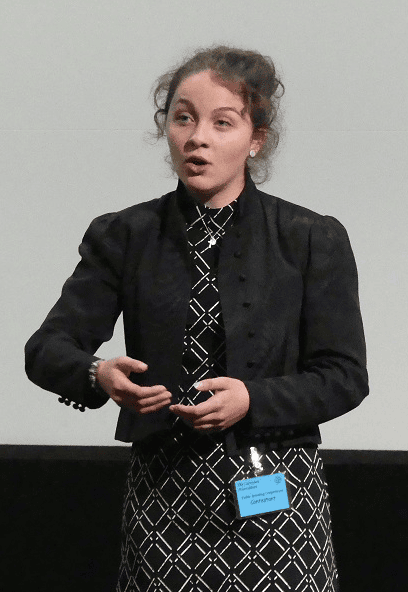
The winning speech
Topic: The law should not always be obeyed.
How many of you have broken the law? The speed limit for example? We all take such minor infringements for granted but our purpose today is to consider exactly how far the laws of the land should be respected, and how far an individual might be permitted to make a stand.
Often we find there is a conflict between personal belief, just laws and the laws of a country. Even in democratic countries laws will come into conflict with a justified moral code. Two recent laws in France have specifically targeted the Muslim community. In 2004 wearing a headscarf was banned in public schools; this heralded a national decision on ‘l’affaire du foulard’ or ‘the headscarf issue’. As a result Muslim girls have been forced to separate an external expression of their faith in an essential part of their lives, school. However the Government in France does state that there should not be outward expressions of faith in government owned institutions, including state schools. A further law though in 2010 however meant that headscarves have now been banned in all public spaces. Veiled women have been refused entry to university classes, banks, and doctors’ offices. The fact that this has become an issue in France, where the tradition of freedom of speech is very strong highlights the controversial nature of the relationship between laws and freedoms. Is it right to suppress a person’s ability to express their faith?
However, France is a secular society. You should obey the law of the country that you live in and you have accepted those rules by living there. This is not to say that if you do disagree with the law you cannot change it, in a democratic country your voice will be heard. The law should be changed not defied. The political philosopher John Rawls describes how we have “a natural duty to abide the rules of a just institution”. If you are benefiting from the stability of an established country you have the duty to abide by their rules. In theory, laws should ensure a stable society and is in place to prevent anarchy.
However let’s take the example of an undemocratic society, the communist regime in China. Liu Xiaobo spoke out through the power of his written work and in 1989 he was imprisoned for the first time. He then spent the rest of his life in a battle of fighting injustice and suffering at the hand of his country’s wrath.
During his fourth prison term he was awarded the Nobel Peace Prize in 2010 for “his long and non-violent struggle for fundamental human rights in China”. It is not always the case the society you belong to will be just. Then, it may be morally permissible to break the law to right specific injustices. As Aquinas said “an unjust law is not worthy of obedience”.
Society functions on the assumption that laws laid down by the authorities will be followed. We have considered examples on both sides of this debate however it is perhaps worth bearing in mind the wise words of Sir Thomas More from Robert Bolt’s play ‘A Man for All Seasons’ when the young William Roper challenges Sir Thomas over his acceptance of the Devil’s law, Sir Thomas replies “This country is planted thick with laws, from coast to coast, Man’s laws, not God’s! And if you cut them down…do you really think you could stand upright in the winds that would blow then? Yes, I’d give the Devil benefit of law, for my own safety’s sake!” Although we know there will always be instances where breaking law is permissible, as a general precedent, law is implemented to protect and not exploit individuals.
 To foster brotherly love among our members and to develop social bonds among our members and their families.
- To support one another in the practice of our Faith.
- To support and encourage Brothers, their families and widows as needs arise.
- To support Brothers in difficulty or need including maintaining and administering benevolent funds through the Catenian Association Benevolent and Children’s Fund.
- To advance the interests and development of young Catholics and to assist them in the choice or pursuit of a career, including the promotion and support of the Catenian Association Bursary Fund.
- To help our clergy and to encourage and support vocations to the religious life in appropriate ways.
- To support charities which the Circle, Province or Association considers are worthy and relevant.
 To foster brotherly love among our members and to develop social bonds among our members and their families.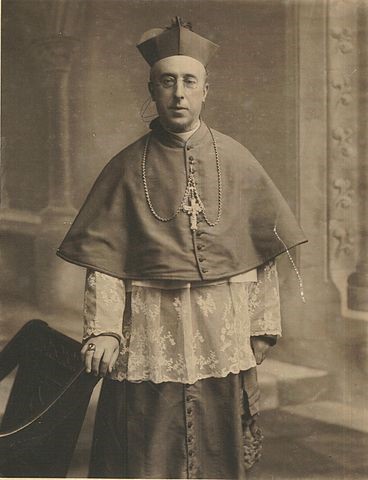
How did we start?
The Catenians were established in Manchester in 1908 at the behest of Louis Casartelli, the then Bishop of Salford. For the first two years the Catenians were known as “The Chums Benevolent Association, and its original and essential characteristics were typical of many male societies established in the period before the First World War.
Bishop Casartelli was one of a number of Bishops who were anxious to see Catholic communities break the bonds of restricted education, low social status, and limited political power and influence. They acknowledged that the Chums, and later the Catenians, were a force for good and a vehicle for action.
The name Catenians derives from Catena, the Latin word for Chain. Each member is seen as a link upon which the strength of the whole chain depends.
The Association spread rapidly across the UK but did not become established offshore for almost 50 years. Since then development followed largely on colonial lines. Overseas growth in recent years has been rapid. We now have some 10,000 members in Africa, Australia, Bangladesh, India, Ireland, Malta and The Holy Land as well as the UK.
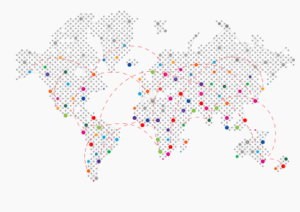
Members join the Association by being enrolled into a local branch. Depending upon their size these branches are known as Groups or Circles. In turn the Groups and Circles are grouped administratively into Provinces, which support them. Each Province elects a Director to serve on the international governing body. If there are insufficient Circles in a region to justify a Province, they are administered by a Development Director.
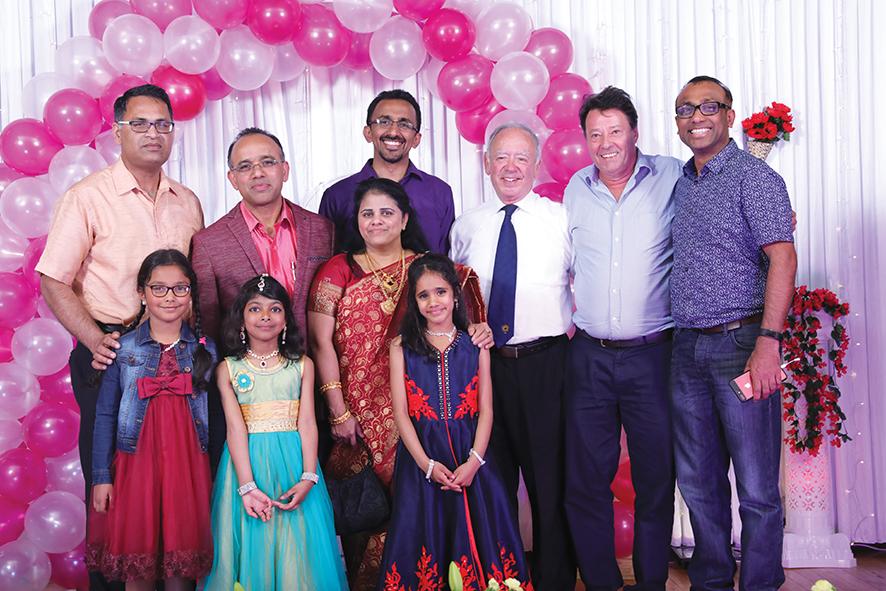
Catenian membership offers deep and lasting friendship and support to Catholic men at all stages of their lives, whether married or single. This friendship is based on the firm foundation of a shared faith and is enjoyed by their wives (whether Catholic or not), their children and continues after a member’s death with widows being supported and involved on a continuing basis. The monthly meeting provides a time for relaxed enjoyment among supporting and faithful friends. The varied local social programme caters for all ages and provides a light-hearted environment in which friendships flourish.
Whatever difficulties you face in life there will be members and their wives committed to helping you. Should a Brother suffer financial difficulties there is a benevolence fund to provide assistance.
Prospective members are invited (without obligation) to join in one or two social activities and then come along to a couple of meetings as an observer: If at that point you feel you (and your wife if you are married) would enjoy the benefits of membership then you would make a formal application through the Catenians with which you have made contact.
Discover more about Catenian Membership
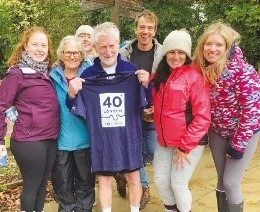
The Catenians are much easier to experience than explain. That is why those wishing to find out more before applying for membership are encouraged to talk first with other Catenians (chances are there are several in your parish). Prospective members are invited (without obligation) to join in one or two social activities and then come along to a couple of meetings as an observer: If at that point you feel you (and your wife if you are married) would enjoy the benefits of membership then you would make formal application through the Catenians with which you have made contact.
If you do not know any Catenians locally please click:
And we will put you in touch.
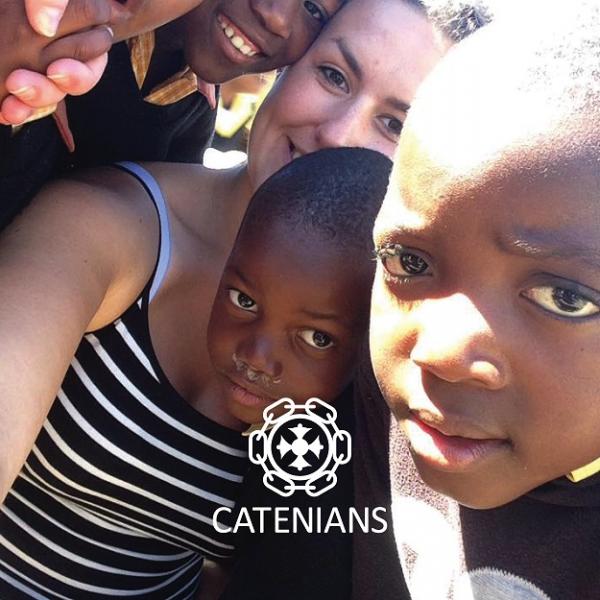 While the Catenian Association is not by definition a “charitable” organisation it does reflect the charitable nature of our members.
For example, Circle Presidents usually have a charity that they raise funds for during their year of office. It is estimated that over £300,000 is raised each year in this way before adding in the further tax related relief which may be claimed by the charities.
Other examples are listed below.
Young People
The work on assisting our young people continues to be developed. The key aspects of this include:
- A dedicated Bursary Fund to support young Catholics who want to work on projects around the world to assist communities less fortunate than ourselves. Grants are also made to young people working as helpers on Diocesan and HCPT Pilgrimages. The Catenians are one of the main sponsors of Flame which takes place every two years at Wembley Arena. For more information please see: www.cymfed.org.uk/flame2019/
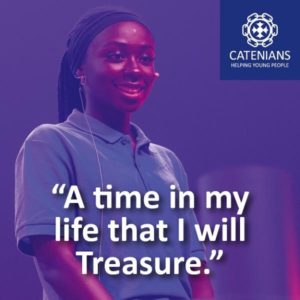
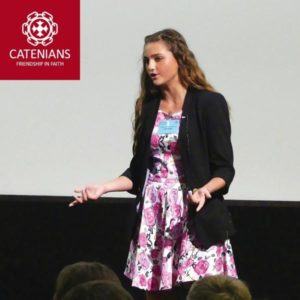
- Organising an annual Public Speaking Competition with local heats which help young pupils of Catholic schools develop their speaking and presentation skills. Cheques and trophies are presented to the winners and their schools.
- Appointing School Liaison
Officers in each Circle to provide assistance such as conducting mock interviews, advising on CV
preparation and organising career events. - Liaison with a cross-section of universities to help support their University Chaplaincies to provide assistance such as conducting mock interviews, advising on CV preparation and organising career events.
Spiritual
The Catenian Association actively supports the work of the National Office for Vocations in its building of vocations awareness including prayers, Masses and regular financial contributions
Benevolence
The Catenian Association supports members and their dependants who are in difficulty or need. The dedicated Benevolent Fund provides financial aid to help to alleviate hardship. The Fund is examining how it can assist similar charitable causes in appropriate circumstances.
Circle Charities
Most Circles support charities each year and the chosen charities are often changed each year.
The charities vary from Alzheimer’s to projects in Zambia and from small local charities to well known international ones.
National Public Speaking
Public Speaking video https://youtu.be/vqMwsaVDspk
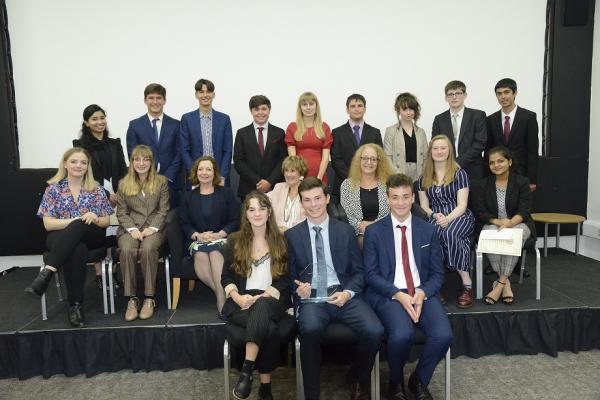
The 2025 National Final of the Public Speaking took place at The Manchester Conference Centre on 7th September.
Fifteen speakers took part from all areas of the country and thanks must go to the local organisers for their work in organising their Provincial competitions. The schools and colleges have prepared their students and they too must be thanked for their help together with parents and of course the students themselves.
The participating students, in the order they spoke, together with their topic is as follows:
Competitors
Province: Student: School:
7 Ruby Maxted St Gregory’s Catholic School, Kent
Subject: Gender Inequality in Sport
19 Elizabeth Vanega St Richard Reynolds Catholic College, Middlesex
Subject: The Cost of Complacency, Ukraine’s Fight for Survival and the world’s Moral Test
12 Joanna Etukudo St Augustine’s College, Wiltshire
Subject: Does the Devil wear Prada?
6 Theresa Collins Hagley Catholic High School, Worcestershire
Subject: Is virtue required for Happiness
5 Natasha Nnaji St Aidan and St Oswald, Sunderland
Subject: Redefining Success
1&17 Solomon Te St Bede’s College, Manchester
Subject: Manners and Politeness are so Yesterday
8 Cameron Fyfe St Joseph’s Roman Catholic High School, Slough
Subject: The ballot is stronger than the bullet (from a chemists point of view)
11 Matthew Farah St Peter’s School, Southbourne, Bournemouth
Subject: The Effects of Kinesis
15 Shanley Robinson St Mary’s Catholic High School, Chesterfield
Subject: Dependency on Technology is making humanity less Intelligent
4 Charlotte Gray The Convent High School, Chester
Subject: There is nothing Domestic about Violence
2 Ben Leeder Notre Dame High School, Norwich
Subject: The History of the World is not just the Biography of Great Men
22 Sophie Muir St Mungo’s High School, Falkirk
Subject: Femicide, the Global Crisis
18 Ruby Arliss St Paul’s Catholic College, West Sussex
Subject: Should the UK legalise Euthanasia?
3 Szymon Bakarlarski All Saints Catholic School, York
Subject: A little learning is a dangerous thing
14 Will Mountfield St Columba’s College, St Albans
Subject: You Don’t have Free Will, Now what?
Previous Winners
Year Name School / College
2014 Lisa Shoko Archbishop Beck Catholic College, Liverpool
2015 Emily Harry Notre Dame RC School, Plymouth
2016 Percy Fagent St. George’s College, Weybridge
2017 Miriam Isaacs Princethorpe College, Rugby
2018 Peter Firbank Blessed Robert Sutton College, Burton-on-Trent
2019 Daniel Moloney Finchley Catholic High School, Finchley
2022 Clare Aspray Sacred Heart High School, Newcastle-upon-Tyne
2023 Kuziva Mutandwa St Bede’s College, Manchester
2024 Finn Curtis Richard Challinor School, Kingston upon Thames
Organisers
Committee Members: Graham Sivills (Chairman), Harish Narotham (Secretary),
Mike Swarbrick (Treasurer), Charles Flannery (Minute Secretary), Phil Brown, Stuart McNeill, Mike Brennan and Mark Kernberg.
We are all very appreciative of the help and support given by:
Photography: Pete Harrington Microphones: Maggie Brennan.
Timekeeping: Bernard Gagan and Chris Marsden.
We also thank many brothers and their wives who give us their support in stewarding and carrying out the many tasks that are needed on the competition day itself. The varied topics enthralled the audience and certainly had been well researched and presented. Indeed the standard of the speeches was as high as ever and presented the adjudicators with much to ponder.
Before the announcement of the winner of the competition there was a short presentation about the Catenian Bursary Fund, compiled by Harish Narotham, a member of Province 17.
The distinguished adjudicators were, Ms Karen Carter, Rt Rev John Arnold Bishop of Salford and Mr James Power. Before the presentation of certificates and prizes each contestant was given short positive feedback on their individual speech.
The adjudicators after their difficult deliberation, as a result of the high standard of the students, were unanimous in their decision of the top three speakers who were:
In first place Elizabeth Vanaga Finn Curtis from Province 19, in second place Solomon Te from Provinces 1&17 and in third place Will Mountfield from Province 14. All three received cheques, cheques for their schools and certificates. The other contestants received money and a certificate.
Brother National President Gerry McCormack presented the prizes and certificates and complimented all the participants for their speeches. He concluded by thanking everyone for their attendance and gave thanks to the organising committee.
The 2026 National Public Speaking Final will be held on Sunday 6th September 2026 at the Manchester Conference Centre starting at 1.30pm. It is hoped that nearly all Provinces will be sending the winner of their local competitions.
The National Final format is outlined as follows:
The Catenian Association has a firm commitment to helping Youth. Our support for CYMFED, through sponsorship of the Flame events as well as Embrace in Liverpool, Brightlights in Stafford, Youth 2000 in Walsingham are a few of many examples of major events. Support has also been given to youth projects in West Somerset and Portsmouth. The Public Speaking competitions for 16 to 18 year olds is now firmly established throughout Great Britain culminating in the National Final in Manchester which goes from strength to strength.
Through the work of the Youth Working Group of the Great Britain National Council progress has been made in liasing with Diocesan Youth services and University chaplaincies. There is representation on Diocesan Youth committees and it is hoped again to have an input at the University chaplains conference. The collation of these and other Catenian youth initiatives is ongoing.
Safeguarding Policy for the catenian Association
Should you wish to know more about the Catenian Association’s work with youth please contact: Lorraine Gatehouse membership@thecatenians.com
By Clicking on any of these links you will be redirected to an external website, the Catenian Association has no control over nor does it endorse the content of any external websites.
- The Catenian Rosary Group: https://www.catenianrosary.com/
- Catholic Military Association https://www.catholicmilitaryassociation.org.uk/
The Catenian Association in Australia
- Australia Catenians: https://www.thecatenians.org.au/
The Catenian Association in Great Britain
- Province 1: http://www.thecateniansp1.co.uk/
- Province 6: https://catenians-province6.org/
- Province 7: https://cateniansprovince7.com/
- Province 12: www.thecatenians.uk/province12
- Province 18: https://cateniansprovince18.org.uk/
- Province 19: https://www.cateniansprovince19.org.uk/
The Catenian Association provides practising Catholic laymen and their families with friendship, social activities and support.